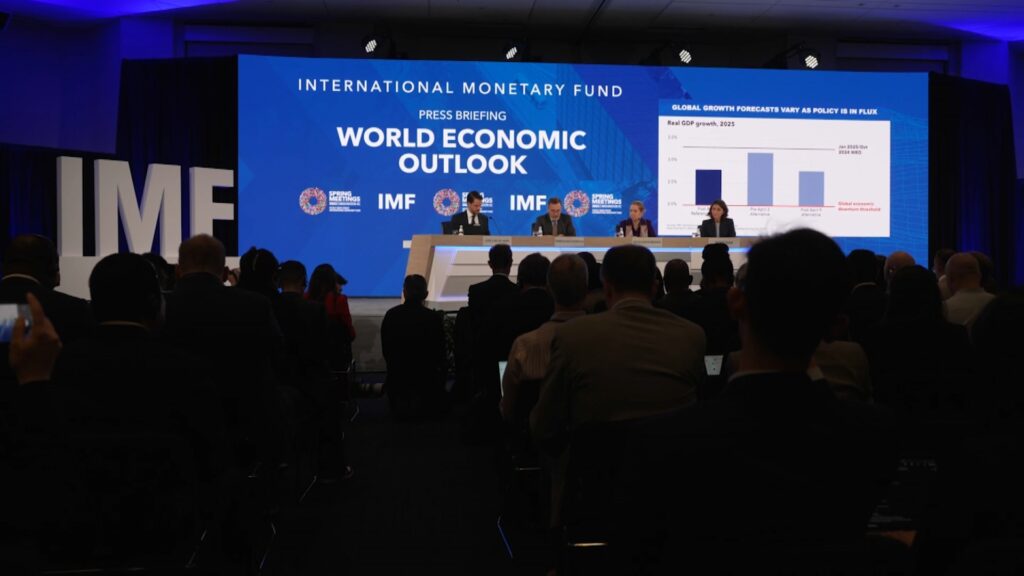
The International Monetary Fund’s July 2026 World Economic Outlook update holds its global growth forecast broadly unchanged from April, projecting world GDP expansion of 3.0% in 2026 and 3.4% in 2027 (ProPakistani). Behind that stable headline number sits a considerably more polarised picture: the Fund explicitly frames 2026 as a year in which artificial intelligence-driven demand is lifting economies integrated into the global technology supply chain, while ongoing conflict is squeezing energy-importing and financially vulnerable economies simultaneously.
The Two-Speed World, Country by Country
Nowhere is the Fund’s framing more visible than across the nine markets most exposed to this year’s dual shocks. Malaysia and Singapore, both deeply embedded in global semiconductor and AI infrastructure supply chains, have seen 2026 growth forecasts revised upward through the year despite the Iran war, with Maybank raising its Malaysia estimate to 4.9% and multiple banks citing AI-driven exports as the offsetting force against oil-shock costs (Xinhua). China, despite its own frontier-technology export boom, missed its own growth target for the first time since the pandemic, at 4.3% for Q2, precisely because domestic demand and property investment have not benefited from the same AI tailwind as its export sector (NPR).
The Losers Column Is Longer Than the Winners Column
Pakistan sits on the losing side of this divide. The Fund’s own Article IV-linked modelling shows Islamabad’s current account deficit worsening by up to 0.4 percentage points of GDP in FY27 under its baseline war scenario, and by roughly 1.5 percentage points of cumulative GDP damage under its adverse scenario (IMF Country Report 26/101). The UK fares little better: the OECD, working from similar assumptions about energy exposure, has cut its 2026 UK growth forecast to just 0.7% — the largest downgrade among G20 advanced economies — and expects UK inflation to reach 4%, second only to the United States in the G7 (HomeOwners Alliance). Canada’s central bank separately projects global GDP growth slowing to 2.75% in 2026 “mostly because of the effects of the Middle East conflict,” a materially more pessimistic read than the IMF’s own headline figure (Bank of Canada).
Global Disinflation Has Stalled
The Fund’s July update flags that global disinflation has stalled even as risks have become more balanced compared with April, urging policymakers to maintain price stability, rebuild fiscal buffers and strengthen economic resilience (ProPakistani). That guidance sits directly behind the Bank of England’s and Bank of Canada’s parallel decisions to hold rates rather than cut, despite softening growth in both economies — a coordination of caution across advanced-economy central banks that is easy to miss when each rate decision is covered in isolation.
Indonesia: A Case Study in Compounding Risk
Indonesia illustrates how the IMF’s “vulnerable economies” category can compound quickly. The Strait of Hormuz shock alone drove a $3.76 billion oil-and-gas trade deficit in May, ending a 72-month streak of trade surpluses, while separately the rupiah’s slide to a level weaker than during the 1997-98 Asian financial crisis reflects fiscal credibility concerns entirely unconnected to the energy shock (Indonesia Investments; The Diplomat).
Why This Cross-Market View Matters More Than Any Single Country Report
Reading any one of these economies in isolation obscures the pattern the IMF is describing: this is not a uniform global slowdown, but a bifurcation driven by two independent shocks — an AI capital-expenditure supercycle and a Middle East energy shock — that happen to be hitting different economies with different intensities depending on their trade composition and financing structure.