While most coverage of the UK economy in July 2026 has focused on Andy Burnham’s expected succession as prime minister and the Bank of England’s rate decision, a much larger structural proposal has slipped past most business headlines: a plan to abolish income tax altogether.
The proposal itself
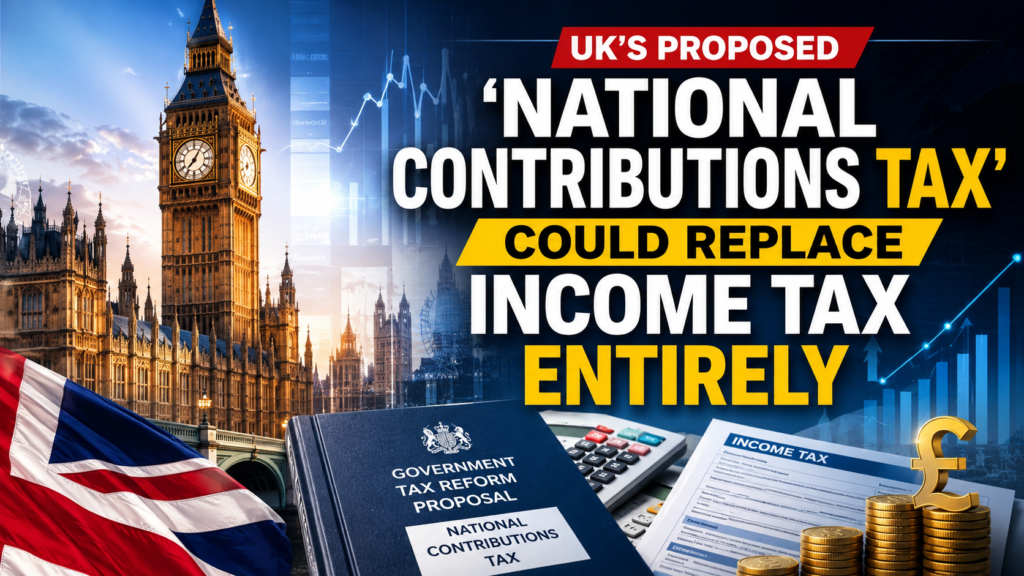
Lord O’Neill of Gatley — the former Goldman Sachs chief economist and coiner of the “BRICS” acronym — has joined five other economists in calling for a complete overhaul of the UK tax system. Their report, produced with the UCL Institute for Global Prosperity, proposes a new single “national contributions” tax that would replace income tax, National Insurance, and taxes on capital gains, dividends, and inheritance, according to the Credit Protection Association’s business briefing. The same report proposes replacing stamp duty with a 1% levy on property valuations.
The economists argue the changes could boost fiscal headroom by £38bn and raise an additional £18bn in revenue — numbers large enough to materially change the UK’s fiscal trajectory if implemented, though the proposal remains at the report stage rather than draft legislation.
Why this is landing now
The timing isn’t accidental. The report arrives as Keir Starmer’s resignation mid-June opened the door for Andy Burnham to become prime minister, and as Hanbury Wealth’s July economic review notes, Burnham has already signalled cost-of-living support could be an early policy priority — while also stressing there would be no abandonment of existing fiscal rules. A single-tax system that simplifies collection while preserving revenue is exactly the kind of structural reform a new government facing “precarious public finances” and “unresolved questions” about growth might reach for.
The backdrop makes the case more urgent. UK growth in Q1 2026 came in at 0.6%, with 2025 growth revised down to around 1.3%, according to the Office for National Statistics data cited by Hanbury Wealth. Business confidence, meanwhile, has deteriorated sharply — the Institute of Directors’ sentiment index fell to minus 61 in June from minus 53 in May, with revenue expectations dropping to their lowest reading of the year, per CPA’s coverage.
The underreported angle: what a single-tax system would mean for businesses
Most coverage of UK tax policy in 2026 has focused narrowly on rumoured changes to individual rates or thresholds. What’s missing from that coverage is the compliance-cost dimension. A unified “national contributions” tax replacing five separate tax regimes (income tax, NI, capital gains, dividends, and inheritance tax) would fundamentally restructure how UK payroll and accounting systems calculate and remit tax — a multi-year systems and compliance transition for every UK employer, payroll provider, and accounting firm, regardless of the eventual headline rate.
For financial services firms specifically, this compounds an already difficult backdrop. Business activity in the UK financial services sector “declined sharply” per the CBI’s net reading, falling from 65 in March to -58 in June, with firms reporting weaker profitability, according to CPA’s business briefing. Elizabeth Hart, senior investment director at Rathbones, has said clients are already anxious about potential changes to tax and financial planning rules — anxiety this proposal, even at the discussion stage, is likely to amplify.
What happens next
Nothing here is legislated, and a report from six economists — however credentialed — is not government policy. But the proposal lands at a moment when a new prime minister is actively reshaping fiscal priorities, and when the UK’s underlying growth and business-confidence data give a incoming government real incentive to consider structural revenue reform rather than incremental rate tinkering. Businesses and high-net-worth individuals with UK tax exposure should treat this as an early signal worth tracking rather than a settled reform, particularly given how directly it would interact with existing capital gains and inheritance planning.
FAQ
What is the UK’s proposed national contributions tax? A single tax proposed by UCL Institute for Global Prosperity economists, including Lord O’Neill of Gatley, that would replace income tax, National Insurance, capital gains tax, dividend tax, and inheritance tax with one unified levy.
Would this replace stamp duty too? Yes — the same report proposes replacing stamp duty with a 1% levy on property valuations.
Is this UK government policy? No. It is a proposal from independent economists, not enacted legislation, though it arrives as a new prime minister is shaping fiscal priorities following Keir Starmer’s resignation.